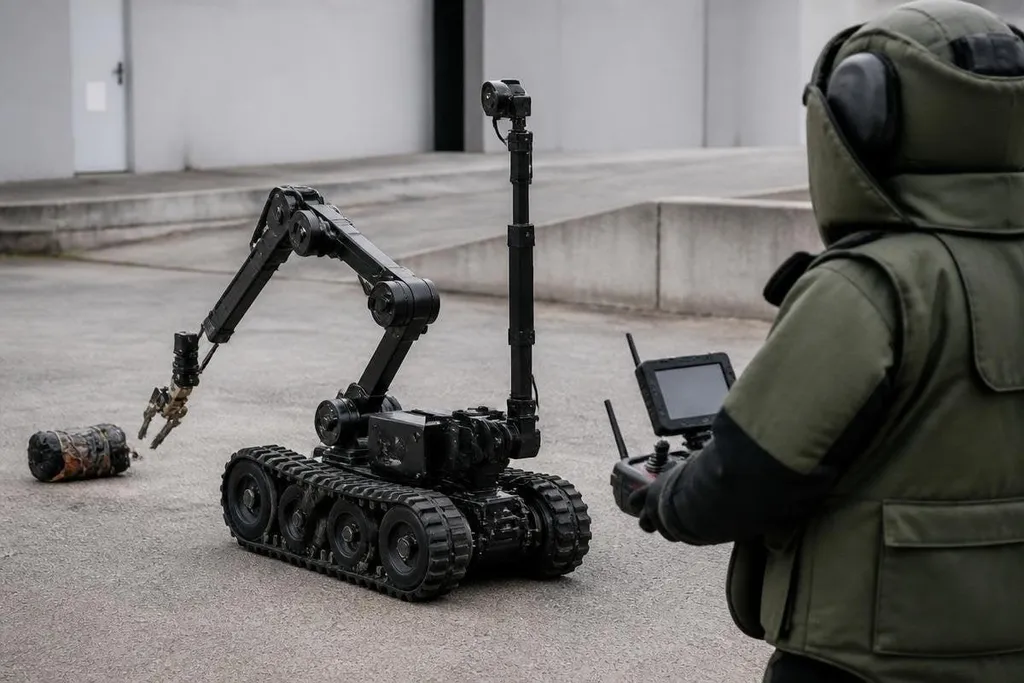
A bomb disposal robot has one job: let a trained operator inspect and handle a dangerous object from a safer distance. New systems should be judged by the work they complete, the evidence behind each claim, and the limits operators face.
Quick read
- Ask for tested figures on reach, payload, runtime, and communications range.
- Check how the robot behaves when cameras, links, or motors fail.
- Treat autonomy claims as unproven until operators can verify each action.
The arm still decides the outcome
A tracked base can cross rough ground, but the arm and gripper decide whether the robot can inspect a device, move an object, or place a tool with care. A longer arm may reach farther, yet reach alone says little about control at the tip.
Buyers should ask for the arm’s payload in kg at its full reach, not only the highest figure near the body. They should also ask for reach in mm, joint speed, tool weight, and the smallest object the gripper can hold without slipping.
That information connects the specification to the task. A robot may carry a heavy disruptor but struggle with a thin wire or a small latch. Operators need both force and fine movement.
Cameras and control links matter just as much
Operators work through cameras, screens, controls, and radio links. The picture must remain useful when the robot turns, enters a dark space, or moves behind an obstruction. A delay between the control input and the robot’s movement can make careful work harder.
A proper test should record video quality, delay in milliseconds, link range in metres, and what happens when the link drops. The robot should stop or hold its position in a known way, and the operator should know that the link has failed.
For bomb disposal teams, bomb disposal robotics reporting should tie each claim to the test site, date, control link, operator role, and task result. That record sets up the next question: can autonomy handle one narrow job before it takes on more?
Autonomy needs a narrow job
Autonomous systems may help the robot map a room, keep a camera pointed at an object, or return along a known route. Those tasks can reduce the operator’s workload, but they don't remove the need for human control during disposal work.
A useful system states what the software can do without help. It also records when an operator takes control, loses the link, changes tools, or stops the robot. Without those records, a smooth video leaves too many questions unanswered.
The evidence should include the test area, lighting, floor surface, object size, and number of attempts. A single successful run can't show how the system behaves after a motor stall, blocked view, or changed object position.
The parts people forget to measure
Field work exposes problems that a product sheet may leave out. Batteries need to be changed, tracks collect debris, cameras need cleaning, and cables can limit where the robot goes. A system that takes too long to prepare may be hard to use during a real callout.
Ask who can repair the robot, how long replacement parts take to arrive, and which parts the disposal team can change on site. Check the weight of the full system, the size of its transport case, and the power supply it needs.
No evidence pack is available for this topic, so current model names, prices, test results, and deployment counts can't be verified here. I’d skip any buying decision based on a polished video alone.
A practical buying check
Use this list when a supplier presents a new system:
- Task fit: Name the object, tool, surface, and reach needed for the job.
- Arm data: Record payload at full reach, tool weight, joint speed, and grip range.
- Operator view: Measure camera delay, low-light performance, and link range.
- Failure response: Test a lost link, low battery, blocked camera, and motor stall.
- Field support: Confirm repair training, spare parts, battery changes, and transport weight.
- Test record: Ask for dated results, the test setup, failed attempts, and raw video.
New systems will earn trust through repeatable tests rather than dramatic movement.
Until makers publish those results, the useful question is not how much the robot can do on its best run, but what the operator can safely control on the worst one.